Writing has slowed down for me somewhat because I'm more accepting of my unanswered questions and less certain that I'll arrive at answers. I don't spend as much time reading and pondering the nature of God. I've spent a fair amount of time recently learning the new skill of couponing. I've spent numerous hours on blogs dedicated to couponing and bargain shopping and I've made some significant headway.
However, I do need to give attention to a spiritual matter that directly affects our sons. And the matter is prayer. This is something I have largely given up on because I don't really believe that whoever or whatever I pray to is going to answer or react in any way. I don't see prayer changing anything by affecting God's behavior. Now that is not to say that I don't believe prayer can have a significant affect on the petitioner. In fact, I believe that prayer does affect our attitudes and heart when we pray. This has renewed my interest in pursuing meditation more diligently, as I think the same effects are likely achieved without the requisite belief in a God who is listening to our every prayer and responding.
Out of force of habit, I suppose, we pray as a family before meals when we eat together. One night, a couple of weeks ago, my husband led a prayer before dinner, a fairly quick and perfunctory one. My youngest son was sick with bronchitis. After the prayer, my son immediately said, "You didn't pray for me to get better." He wanted this prayer, so my husband prayed for his health. It meant a great deal to both my boys, who actually sat very still and quietly during the second prayer, as opposed to trying to sneak a bite or glancing at the other brother to catch him in the act of eating. I felt guilt over this omission and wondered if the boys thought we weren't concerned enough about our son's health.
In the Christian community, prayer is a primary way of communicating concern for another. And of course, if you believe prayer can change the actions of God, it is a way to improve the outcomes for others. My husband and I are raising our children in this culture, so it's no surprise they are developing this understanding of prayer. I do believe it's a valuable practice, whether or not anyone hears the prayer, but it's just so hard for me to do. I feel a need to come to some sort of way of approaching this practice, especially in the context of my family. And given that I still feel a bit on the fence about my beliefs as does my husband, it's a challenge to know what to teach our children. So, that's my current conundrum. Any thoughts?
Wednesday, July 18, 2012


Sunday, June 17, 2012
Long Way Home
Recently, D'Ma wrote a post on looking for community now that she is no longer part of her former church. The loss of community following deconversion seems to be the most painful part of the experience. I've been thinking about this a great deal lately as I attempt to enter a new congregation and assimilate. I have found small reasons to be hopeful that I will find a place there, though there are moments I feel it may be a matter of time before the discomfort of the poor fit grows too large to ignore. I often ask myself "Why?" Why am I going, week after week? I don't always answer myself. However, a week ago, I became more aware of my motivations during a workshop I attended where I learned a new form of therapy. The therapy is called EMDR and involves helping people process memories and the beliefs related to them, particularly those of a traumatic nature. There's some free association involved, which can take on a dream-like quality at times. The participants of the workshop practiced the therapy on each other. (That way we can mess each other up instead of our clients :) I chose to process a memory that was not traumatic, though it still pained me. It was related to my dad so I didn't anticipate addressing my faith crisis at all. However, during EMDR I was hit with the realization that I am partially holding onto Christianity as a way to hold on to my dad, who died 5 years ago. By maintaining the faith he passed on to me, I continue to have a sense of connection to him, despite his death. Community and connections mean so very much, don't they? Death isn't always strong enough to dissolve them. During the EMDR, I also experienced some vivid imagery that I thought I'd describe to you. It felt very much like dreaming. Feel free to draw your own conclusions about it and share how it might relate to your own experiences.
I found myself standing by several pools of water, intended as baptistries. My family stood nearby. I told them, "I have to go now." I walked away from the pools of water, toward a road. Abruptly, the scenery changed from a warm, green land to a frozen wasteland, as I approached the road. I stood at the beginning of the road and looked out at the snow covered land in front of me. My husband stood by the edge of the road, which I was relieved to see. I also saw dark silhouettes of people framing the road. I even saw my family slowly walking over towards us. I looked back and saw the sun shining over the pools of water. I said, "I wish the sun could come over here." Someone behind me said, "The sun can't come over here." Then I felt a warm fur coat being draped over me. I was told, "you can be kept warm with this." I still wanted the sun shining over us, but I turned and we all walked away from the water. I asked, "Is there any green here?" I wanted to see some grass, but I could only see snow. I remember being amused that some penguins waddled across our path. Dagoods spoke up and said, "Why don't we all go skiing?" (Just like him to suggest an athletic activity). We all skied, though I finally said, "I'm still cold." Someone suggested we go drink hot chocolate, which we did. Afterwards, I remarked that I still wanted to see some green. Doug B told me that he could take me to see some green but it was far away. I told him I wanted to go, despite the trip being long. He told me to climb aboard his bus and we drove off into the distance. And during the drive, I could hear the Steven Curtis Chapman song "Long Way Home" playing.
I've been reflecting on this imagery ever since and spoken about it to one of my therapist friends. Several things have come to mind. Losing the light and warmth radiating from it is the challenge I am facing. As I considered what could be the source of the light, the scene in the Bible of Jesus being baptized came to mind. As he emerges from the water, a dove descends from the sky and a voice from heaven says, "This is my son, in whom I am well pleased, listen to Him." Both God and my dad came to mind at that point. In being baptized, I believed both my dad and God were pleased with me. I could be saved and accepted by God, which of course, was pleasing to my dad. In fact, he is the one who baptized me. By rejecting the tenets of my religion, which includes baptism, I am rejecting what gave me the Well Pleasing status, a thought that does leave me cold. It means not being good enough, not being saved, not being part of a community that continues to reinforce my Well Pleasing status, providing me with feelings of warmth, acceptance, and being right. As a child, I was taught that being baptized was the path to salvation, essential for avoiding hell and being right with God. I was obsessed with being right, being perfect. I even worried about my baptism being performed exactly right to avoid being sent to hell. I never, ever felt certain about it. That insecurity about being saved was brought about by my own anxiety which tormented me throughout most of my Christian life. The idea of turning my back on my baptism? The thought literally leaves me cold. I even had to grab a blanket while I write this.
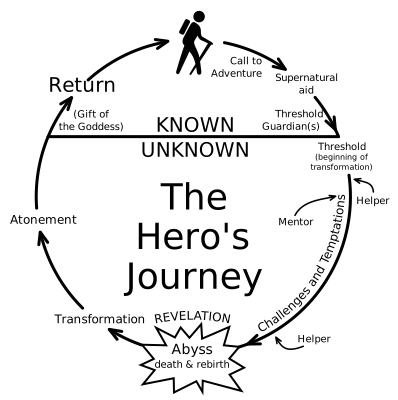
Another thought that struck me about this imagery concerns its similarity to The Hero's Journey* as written about by Joseph Campbell. The Hero's Journey is a common myth found in many cultures which describes how the hero handles the adventure and challenges she must face in completing some type of quest, and the ways taking on the quest transform her. The first step of the journey is called the Call to Adventure. That's where my imagery takes place. When I decided I couldn't stay at the pools of water, I could no longer remain there in the light. I had to strike out on the cold, unfamiliar path before me. My adventure involves finding the "green place" again. A place of warmth, acceptance, feeling right, feeling saved. Of course, part of what makes this an adventure is not knowing exactly where this place is, how to get there, or what could possibly create a green place in the midst of the frozen tundra surrounding me. I suspect is has something to do with leaving behind my obsession with seeking approval and working so relentlessly at being perfect, right, and saved. I suspect it has to do with self acceptance, standing on my own two feet, and being willing to risk rejection and loss of community and status. Am I willing to walk across the frozen, dead ground, to the green space far off in the distance, without the familiar warmth of acceptance? Some of the encouraging imagery in my call to adventure was that I wasn't entirely alone on my journey. I did have family and friends accompanying me. And those of you who read this blog were there, giving me comfort in knowing I'm not alone in my grand adventure. However, ultimately, the adventure is a lonely one in that I must be the one to choose to leave behind the familiar and set off in unfamiliar territory, making decisions that no one else can make for me. This was reflected in the imagery of me boarding the bus alone. Here, I entered new steps in the hero's journey. Once the call to adventure has been accepted, then supernatural aid is given to the hero, which Doug B provided by offering the bus. Once this has been conferred, the hero comes to the next step, The Crossing of the Threshold, where she must leave behind everything known to set out on her quest. This is what occurred when I entered the bus alone and drove off toward the green space. If Joseph Campbell is right, there's much more adventure to be had (and blogged about).
*Here is a graphic depicting the stages of The Hero's Journey:

I found myself standing by several pools of water, intended as baptistries. My family stood nearby. I told them, "I have to go now." I walked away from the pools of water, toward a road. Abruptly, the scenery changed from a warm, green land to a frozen wasteland, as I approached the road. I stood at the beginning of the road and looked out at the snow covered land in front of me. My husband stood by the edge of the road, which I was relieved to see. I also saw dark silhouettes of people framing the road. I even saw my family slowly walking over towards us. I looked back and saw the sun shining over the pools of water. I said, "I wish the sun could come over here." Someone behind me said, "The sun can't come over here." Then I felt a warm fur coat being draped over me. I was told, "you can be kept warm with this." I still wanted the sun shining over us, but I turned and we all walked away from the water. I asked, "Is there any green here?" I wanted to see some grass, but I could only see snow. I remember being amused that some penguins waddled across our path. Dagoods spoke up and said, "Why don't we all go skiing?" (Just like him to suggest an athletic activity). We all skied, though I finally said, "I'm still cold." Someone suggested we go drink hot chocolate, which we did. Afterwards, I remarked that I still wanted to see some green. Doug B told me that he could take me to see some green but it was far away. I told him I wanted to go, despite the trip being long. He told me to climb aboard his bus and we drove off into the distance. And during the drive, I could hear the Steven Curtis Chapman song "Long Way Home" playing.
I've been reflecting on this imagery ever since and spoken about it to one of my therapist friends. Several things have come to mind. Losing the light and warmth radiating from it is the challenge I am facing. As I considered what could be the source of the light, the scene in the Bible of Jesus being baptized came to mind. As he emerges from the water, a dove descends from the sky and a voice from heaven says, "This is my son, in whom I am well pleased, listen to Him." Both God and my dad came to mind at that point. In being baptized, I believed both my dad and God were pleased with me. I could be saved and accepted by God, which of course, was pleasing to my dad. In fact, he is the one who baptized me. By rejecting the tenets of my religion, which includes baptism, I am rejecting what gave me the Well Pleasing status, a thought that does leave me cold. It means not being good enough, not being saved, not being part of a community that continues to reinforce my Well Pleasing status, providing me with feelings of warmth, acceptance, and being right. As a child, I was taught that being baptized was the path to salvation, essential for avoiding hell and being right with God. I was obsessed with being right, being perfect. I even worried about my baptism being performed exactly right to avoid being sent to hell. I never, ever felt certain about it. That insecurity about being saved was brought about by my own anxiety which tormented me throughout most of my Christian life. The idea of turning my back on my baptism? The thought literally leaves me cold. I even had to grab a blanket while I write this.
Another thought that struck me about this imagery concerns its similarity to The Hero's Journey* as written about by Joseph Campbell. The Hero's Journey is a common myth found in many cultures which describes how the hero handles the adventure and challenges she must face in completing some type of quest, and the ways taking on the quest transform her. The first step of the journey is called the Call to Adventure. That's where my imagery takes place. When I decided I couldn't stay at the pools of water, I could no longer remain there in the light. I had to strike out on the cold, unfamiliar path before me. My adventure involves finding the "green place" again. A place of warmth, acceptance, feeling right, feeling saved. Of course, part of what makes this an adventure is not knowing exactly where this place is, how to get there, or what could possibly create a green place in the midst of the frozen tundra surrounding me. I suspect is has something to do with leaving behind my obsession with seeking approval and working so relentlessly at being perfect, right, and saved. I suspect it has to do with self acceptance, standing on my own two feet, and being willing to risk rejection and loss of community and status. Am I willing to walk across the frozen, dead ground, to the green space far off in the distance, without the familiar warmth of acceptance? Some of the encouraging imagery in my call to adventure was that I wasn't entirely alone on my journey. I did have family and friends accompanying me. And those of you who read this blog were there, giving me comfort in knowing I'm not alone in my grand adventure. However, ultimately, the adventure is a lonely one in that I must be the one to choose to leave behind the familiar and set off in unfamiliar territory, making decisions that no one else can make for me. This was reflected in the imagery of me boarding the bus alone. Here, I entered new steps in the hero's journey. Once the call to adventure has been accepted, then supernatural aid is given to the hero, which Doug B provided by offering the bus. Once this has been conferred, the hero comes to the next step, The Crossing of the Threshold, where she must leave behind everything known to set out on her quest. This is what occurred when I entered the bus alone and drove off toward the green space. If Joseph Campbell is right, there's much more adventure to be had (and blogged about).
*Here is a graphic depicting the stages of The Hero's Journey:
Wednesday, May 2, 2012
The Brighter Side of Hell
During my four part series on hell, eternal punishment has taken quite a beating from myself and the other bloggers who visit here (yes, pun intended). So now it's time to reflect. Is there any type of hell that you wouldn't object to? Or even a hell you would like to see remain in the picture? It certainly has staying power. And many continue to hold on tightly. Maybe there are good reasons. Especially if entrance into hell has to do with works, it can give us a sense of ultimate justice in this world. And I for one do long for justice when I see some of the horrific ways human beings treat each other. So maybe there's actually a place in my mind for some sort of works based judgement system that extends punishment commensurate with the crime. However, this does make me nervous when I reflect on my own imperfections. It's so hard to construct a system of punishment I'd actually want to apply to myself.
I think hell has been used to corral and control the masses to greater and lesser extents by the church. The ultimate behavior modification system. We may use the threat of hell on ourselves, worrying we need such external controls to keep ourselves in line. Perhaps at times it does make a difference?
And what if Christianity dropped hell from its doctrine? Would Christianity suffer in any way? Why does Christianity hold on so tightly to hell? When I began to question hell, I also had to question the need for a savior. If Jesus' death doesn't save us from hell, then what is it's purpose? Does Jesus' importance or value diminish if there is no eternal torment from which to save us? Does Christianity actually turn on the gates of hell?
I think hell has been used to corral and control the masses to greater and lesser extents by the church. The ultimate behavior modification system. We may use the threat of hell on ourselves, worrying we need such external controls to keep ourselves in line. Perhaps at times it does make a difference?
And what if Christianity dropped hell from its doctrine? Would Christianity suffer in any way? Why does Christianity hold on so tightly to hell? When I began to question hell, I also had to question the need for a savior. If Jesus' death doesn't save us from hell, then what is it's purpose? Does Jesus' importance or value diminish if there is no eternal torment from which to save us? Does Christianity actually turn on the gates of hell?
Tuesday, May 1, 2012
Mythbusters: Hell is Overcrowded
Finally I am coming to the fourth sermon in the series on hell preached by my minister. In this sermon he spends time answering the objection that too many people are destined to hell. In essence, his argument is that naming Jesus as the only path of salvation is actually the most inclusive option for God. He offers two primary supports for this position. First, compared to salvation by our deeds, salvation through faith in Jesus offers everyone a chance at salvation, regardless of their ability to be good. Here is a quote from his sermon:
(Timothy) Keller is saying that most people believe that the most generous and inclusive way to think about the chair to heaven is to think that any good person can sit in the chair. The way to the chair is to live a good life. No matter your religion, if you live a good life, you’re in the chair. But here’s the problem with that—what about those of us who don’t live a good life? I can’t speak for you, but I can confess about myself—there’s a lot, an awful lot, about me that is not good. There’s a lot in my life that is pure evil. That means that I don’t have a shot at this chair. Only the people who live a good life have a shot. The rest of us are left out. That doesn’t seem very inclusive at all.
But here’s what God’s done. God’s said, “You know what, goodness is not going to carry the day. Grace is. So here’s how this is going to work—anyone, good or bad, can sit in this chair. Anyone—moral or immoral—can sit in this chair. I don’t care what your gender is, what your race is, or what your income is. And I especially don’t care what your moral record is. I don’t care if you’re a prostitute or the President. If you want to, you can sit in this chair.” I want everyone right now to raise your hand. You can sit in this chair. And God finishes, “The only thing I ask is, you let Jesus lead you here. He alone has made it possible for you to sit here.”
My minister's second supporting argument is that God has done absolutely everything he could have done to bring all to salvation through Jesus. Again, another quote from his sermon:
Some may think that God’s intolerant for making salvation dependent upon Jesus. But what more could God have done to create a way for all people to have heaven rather than hell? What greater price could God have paid? What greater sacrifice could God have given? If that’s not the action of a God who loves all and wants all to be saved, I can’t imagine what more it would take. We don’t have to make God sound more loving by pretending that God’s going to save everyone whether or not Jesus is in their picture. If we want to make God sound loving, Jesus is the only picture we need. The cross shows how desperate God is to make sure that we, and every person, does not spend eternity in hell. There is nothing more God could have done to fill that chair. And you can bet that the God who went to such great lengths on the cross will go to similar lengths to give every person on this planet every possible chance to respond to that cross.
In response, I must say I agree that in theory, a model of salvation based on grace has the ability to bring more people to salvation than one based on deeds. And further, if Jesus was a sacrifice for the sins of all humanity, then God has found a way to save everyone at cost to Himself. However, in the churches of Christ, you really don't discuss salvation for long before moral behavior does enter the equation. There seems to be a hybrid grace/works model that we have adopted. Usually, it is framed in terms of "I will show you my faith by my works." This allows for works to be important without them technically counting towards salvation.
I confess that I still don't understand why faith must be relevant to salvation at all, if grace saves us. Why can't grace just, well, save us? Without us asking Jesus to lead us to the "chair" of salvation? And it's one thing to assert that "the God who went to such great lengths on the cross will go to similar lengths to give every person on this planet every possible chance to respond to that cross." However, where's the evidence for it? When we basically see entire countries of people living according to a Jesus-free religion, why should we maintain that they've been given every possible chance to respond to that cross, particularly when they've never heard of it? Or associate it with infidels trying to destroy them? Or find the whole Christian religion to be foreign to their worldview? And this says nothing of people raised in a Christian culture, who nonetheless reject it based on any number of factors predisposing them to disbelief and wariness of the Christian religion. Maybe what I'm saying is that even if God somehow gave everyone a chance to "respond to the cross", not everyone would be able to do so, given their culture, background, personality, experiences, etc. And if it's impossible for everyone to "respond to the cross", where's the grace in that?
(Timothy) Keller is saying that most people believe that the most generous and inclusive way to think about the chair to heaven is to think that any good person can sit in the chair. The way to the chair is to live a good life. No matter your religion, if you live a good life, you’re in the chair. But here’s the problem with that—what about those of us who don’t live a good life? I can’t speak for you, but I can confess about myself—there’s a lot, an awful lot, about me that is not good. There’s a lot in my life that is pure evil. That means that I don’t have a shot at this chair. Only the people who live a good life have a shot. The rest of us are left out. That doesn’t seem very inclusive at all.
But here’s what God’s done. God’s said, “You know what, goodness is not going to carry the day. Grace is. So here’s how this is going to work—anyone, good or bad, can sit in this chair. Anyone—moral or immoral—can sit in this chair. I don’t care what your gender is, what your race is, or what your income is. And I especially don’t care what your moral record is. I don’t care if you’re a prostitute or the President. If you want to, you can sit in this chair.” I want everyone right now to raise your hand. You can sit in this chair. And God finishes, “The only thing I ask is, you let Jesus lead you here. He alone has made it possible for you to sit here.”
My minister's second supporting argument is that God has done absolutely everything he could have done to bring all to salvation through Jesus. Again, another quote from his sermon:
Some may think that God’s intolerant for making salvation dependent upon Jesus. But what more could God have done to create a way for all people to have heaven rather than hell? What greater price could God have paid? What greater sacrifice could God have given? If that’s not the action of a God who loves all and wants all to be saved, I can’t imagine what more it would take. We don’t have to make God sound more loving by pretending that God’s going to save everyone whether or not Jesus is in their picture. If we want to make God sound loving, Jesus is the only picture we need. The cross shows how desperate God is to make sure that we, and every person, does not spend eternity in hell. There is nothing more God could have done to fill that chair. And you can bet that the God who went to such great lengths on the cross will go to similar lengths to give every person on this planet every possible chance to respond to that cross.
In response, I must say I agree that in theory, a model of salvation based on grace has the ability to bring more people to salvation than one based on deeds. And further, if Jesus was a sacrifice for the sins of all humanity, then God has found a way to save everyone at cost to Himself. However, in the churches of Christ, you really don't discuss salvation for long before moral behavior does enter the equation. There seems to be a hybrid grace/works model that we have adopted. Usually, it is framed in terms of "I will show you my faith by my works." This allows for works to be important without them technically counting towards salvation.
I confess that I still don't understand why faith must be relevant to salvation at all, if grace saves us. Why can't grace just, well, save us? Without us asking Jesus to lead us to the "chair" of salvation? And it's one thing to assert that "the God who went to such great lengths on the cross will go to similar lengths to give every person on this planet every possible chance to respond to that cross." However, where's the evidence for it? When we basically see entire countries of people living according to a Jesus-free religion, why should we maintain that they've been given every possible chance to respond to that cross, particularly when they've never heard of it? Or associate it with infidels trying to destroy them? Or find the whole Christian religion to be foreign to their worldview? And this says nothing of people raised in a Christian culture, who nonetheless reject it based on any number of factors predisposing them to disbelief and wariness of the Christian religion. Maybe what I'm saying is that even if God somehow gave everyone a chance to "respond to the cross", not everyone would be able to do so, given their culture, background, personality, experiences, etc. And if it's impossible for everyone to "respond to the cross", where's the grace in that?
Sunday, April 29, 2012
Back in the Running Shoes Again
It's now closing in on the one year mark since I began jogging. The past couple of months had me wondering if I was going to have to call it quits. With my dog's relentless enthusiasm of running as my motivation, I was at the point of jogging about 3 miles most week nights and 6 miles on Saturdays during the winter. Then, suddenly, my knee began to hurt when jogging. I realized I'd begun forgetting to wear my knee brace. I resumed using it. However, it was too late. Soon, I had continuous knee pain. I began wearing my knee brace all the time and looking for the Tylenol. I stopped jogging altogether. I was about to break down and call a doctor when the pain slowly started to subside. I resisted jogging for 2.5 months and was fearful to begin again. However, I tentatively resumed jogging over a week ago. I'm happy to report that so far my knee is cooperating and pain free! I decided to only jog every other day and to nix the 6 mile runs. I'm reluctant to push my luck too far. The first couple times I went out, I felt again that miserable, sputtering beginning to my run, where my side aches, my mouth is dry, and my body cries out to just walk. However, my body is returning reasonably quickly to the rhythm of my pace. It feels good to be out again, pushing myself a bit. My dog absolutely loves it, and would go even faster if I were capable. She propels me on, rarely stopping to sniff along the way. I will enjoy a little more these times we have together, because my knee, or any other factor, may draw them to a close before I'm ready to retire my running shoes.
Tuesday, April 3, 2012
Gathering Ideas for the 'About Me' page
Sabio, over at Triangulations, suggested I add an About Me page on my blog. I have begun that effort, but it is a work in progress. I will compose a few posts that I can hopefully link to my About Me page. I'm not entirely sure what to add to this section, so if you have any suggestions, I'll be happy to hear them.
Monday, April 2, 2012
Mythbusters: Hell is Unrelenting
The third sermon in the hell series preached by my minister was on the severity of hell. He said that hell must be eternal for two reasons.
First, he said hell must be eternal because our sin is against an eternal being. Here is a quote from his sermon:
Colin Smith explains it this way:You may say, "Wait a minute. How can any sin deserve everlasting destruction?... The best answer I ever heard to that question was given by a
friend of mine…He outlined the stages of the following scenario: Suppose a middle school student punches another student in class. What happens? The student is given a detention. Suppose during the detention, this boy punches the teacher. What happens? The student gets suspended from school. Suppose on the way home, the same boy punches a policeman on the nose. What happens? He finds himself in jail. Suppose some years later, the very same boy is in a crowd waiting to see the President of the United States. As the President passes by, the boy lunges forward to punch the President. What happens? He is shot dead by the secret
service. In every case the crime is precisely the same, but the severity of the crime is measured by the one against whom it is committed. What comes from sinning against God? Answer:
Everlasting destruction.
Certainly there are provisions in the law for protecting certain groups of people who have heightened vulnerability, such as children, or those who are at increased risk for being harmed due to their role protecting or leading our country, such as police or the President. I’m not
well equipped to discuss the law or the rationale behind it, so I appreciate any insights on this point. If the point of the stiffer penalties is to protect these groups by deterring crime, then the analogy doesn’t apply to God. He doesn’t need protection in the same sense. Even if we grant that a sin against God deserves stiffer penalties than sin against another human being, I don’t see eternal punishment necessarily following from that premise. Does anyone else? I’d be
interested in dissenting thoughts.
Second, the minister said hell must be eternal because we are eternal beings. I’m not certain that we are eternal beings and neither were the author of a number of Old Testament books, such as Ecclesiastes, Job, Isaiah, and Psalms.
But even if we are eternal, is perpetual punishment the only option? Plenty of philosophers, such as Origen, have envisioned an afterlife where souls have the opportunity to undergo refinement until they finally reach heaven. If we have all eternity, surely that would be time enough
for a good proportion, if not all, to find themselves leaving hell behind. That would seem consistent with biblical passages about God wanting all to be saved. And what about an afterlife scenario where there is no punishment or reward? Why does eternity necessarily involve these two concepts?
While it might be more neat and tidy to conclude that eternal God + eternal man=eternal hell, I haven’t been convinced that the equation must be solved this way. I feel at a bit of a loss in knowing how to address these arguments more meaningfully, so I’d appreciate any ideas from
either side of the debate.
First, he said hell must be eternal because our sin is against an eternal being. Here is a quote from his sermon:
Colin Smith explains it this way:You may say, "Wait a minute. How can any sin deserve everlasting destruction?... The best answer I ever heard to that question was given by a
friend of mine…He outlined the stages of the following scenario: Suppose a middle school student punches another student in class. What happens? The student is given a detention. Suppose during the detention, this boy punches the teacher. What happens? The student gets suspended from school. Suppose on the way home, the same boy punches a policeman on the nose. What happens? He finds himself in jail. Suppose some years later, the very same boy is in a crowd waiting to see the President of the United States. As the President passes by, the boy lunges forward to punch the President. What happens? He is shot dead by the secret
service. In every case the crime is precisely the same, but the severity of the crime is measured by the one against whom it is committed. What comes from sinning against God? Answer:
Everlasting destruction.
Certainly there are provisions in the law for protecting certain groups of people who have heightened vulnerability, such as children, or those who are at increased risk for being harmed due to their role protecting or leading our country, such as police or the President. I’m not
well equipped to discuss the law or the rationale behind it, so I appreciate any insights on this point. If the point of the stiffer penalties is to protect these groups by deterring crime, then the analogy doesn’t apply to God. He doesn’t need protection in the same sense. Even if we grant that a sin against God deserves stiffer penalties than sin against another human being, I don’t see eternal punishment necessarily following from that premise. Does anyone else? I’d be
interested in dissenting thoughts.
Second, the minister said hell must be eternal because we are eternal beings. I’m not certain that we are eternal beings and neither were the author of a number of Old Testament books, such as Ecclesiastes, Job, Isaiah, and Psalms.
But even if we are eternal, is perpetual punishment the only option? Plenty of philosophers, such as Origen, have envisioned an afterlife where souls have the opportunity to undergo refinement until they finally reach heaven. If we have all eternity, surely that would be time enough
for a good proportion, if not all, to find themselves leaving hell behind. That would seem consistent with biblical passages about God wanting all to be saved. And what about an afterlife scenario where there is no punishment or reward? Why does eternity necessarily involve these two concepts?
While it might be more neat and tidy to conclude that eternal God + eternal man=eternal hell, I haven’t been convinced that the equation must be solved this way. I feel at a bit of a loss in knowing how to address these arguments more meaningfully, so I’d appreciate any ideas from
either side of the debate.
Subscribe to:
Posts (Atom)